
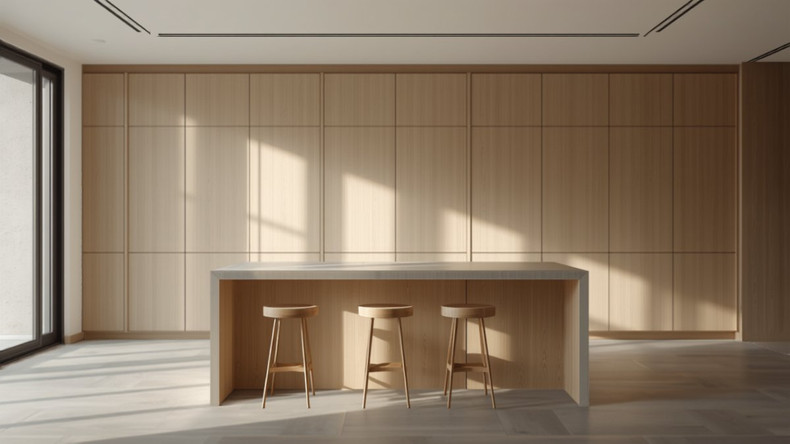
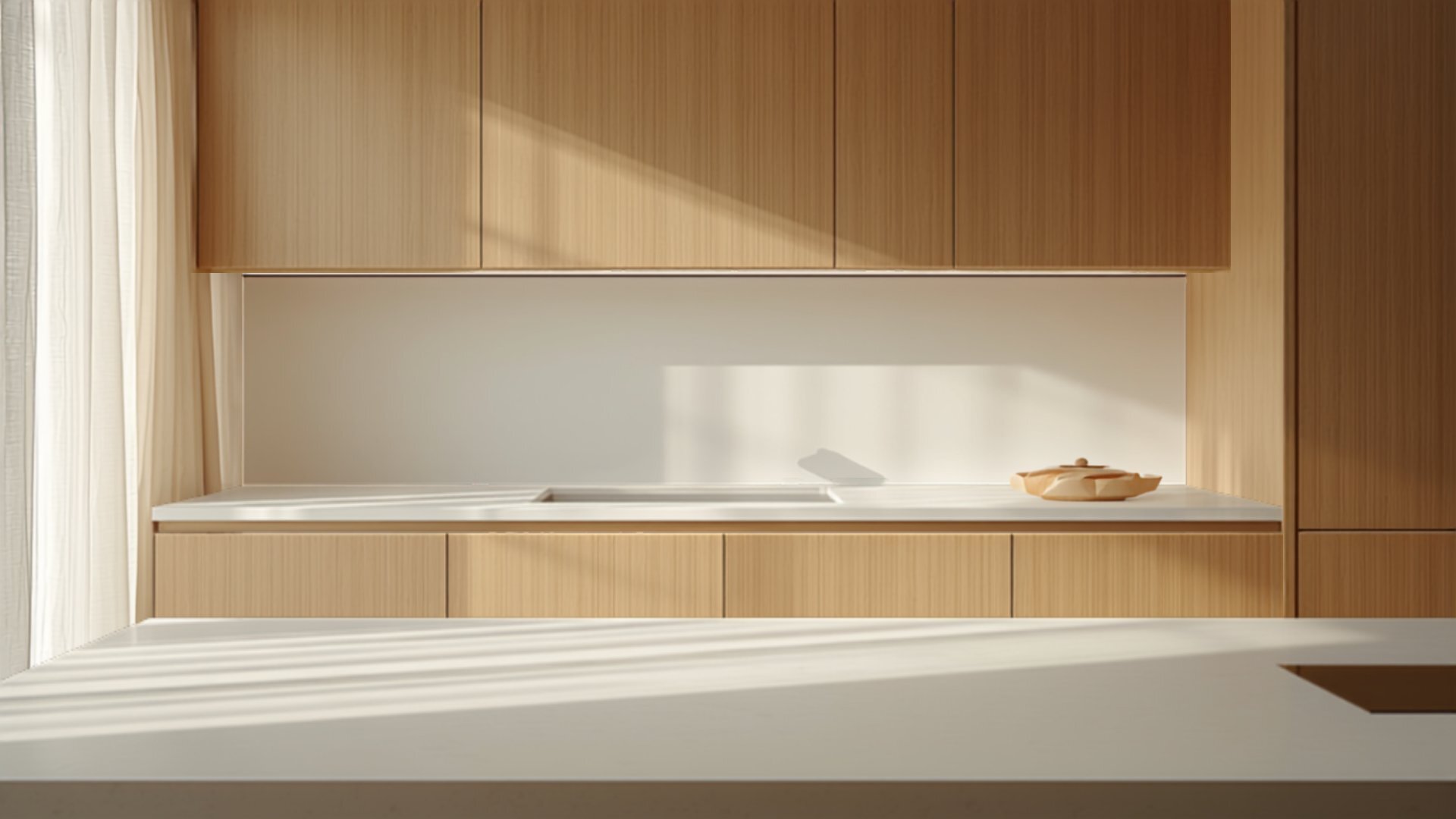
Why Singapore's quietest kitchens are winning, and what to choose, in your HDB or condo, when the moment comes.
There is a moment, just before the kettle starts, when the kitchen is still asleep. The cabinets keep their secrets. The light has not yet decided where to land. The first cup of kopi has not been poured.
This is the hour we design for.
Singapore has spent a decade in love with the high-gloss kitchen — black quartz, brass handles, white marble veneer, dark feature walls. It photographed beautifully. It lived less well. In 2026, the quietest kitchens — Japandi, in light wood, considered down to the handle that isn't there — are the ones holding their grace at year five, year ten, year fifteen.
This is what makes them work, and what to choose, when the moment comes.
What 'Japandi' actually means for a kitchen cabinet
Japandi is the meeting of Japanese restraint and Scandinavian warmth. In a Singapore kitchen, that translates to six visible markers.
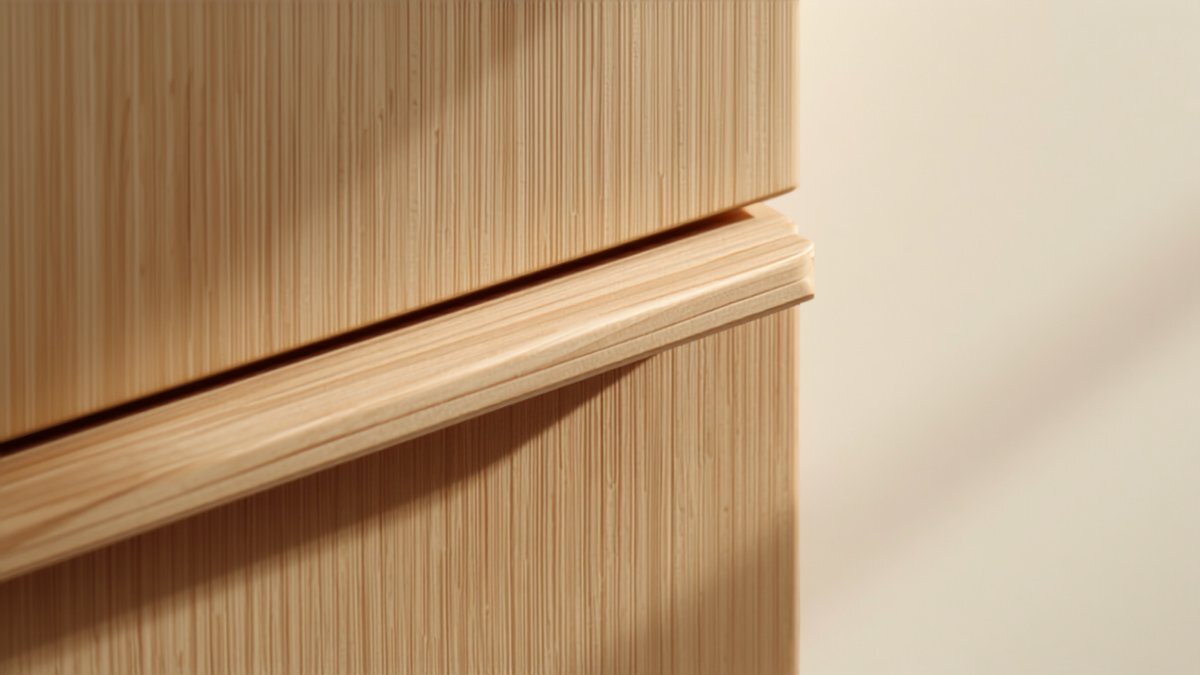
Vertical grain, not horizontal. The eye reads vertical lines as height. In an HDB kitchen with a 2.6m ceiling, vertical-grain cabinet doors quietly add air to the room.
Handleless fronts. Push-to-open, J-pull, or recessed grip. The visual line is unbroken. There is no metal interruption to read against the wood.
Warm-toned wood. Light oak, white ash, warm walnut, or carefully chosen melamine that captures grain truthfully. Cool greys and bright whites belong elsewhere. Tropical light is warm. The cabinetry has to meet it on its terms.
Low profile, generous proportion. Cabinets that don't shout from the wall. Upper units that don't run all the way to the ceiling unless they earn the trip.
Soft-close, everywhere. A drawer should close softly. So should a sentence. Hardware is the part of cabinetry you touch every day — the budget belongs here.
Restraint, then ritual. Japandi cabinetry is built around how the kitchen is actually used. The kueh-tray drawer in the season before Hari Raya. The claypot shelf with breathing room. The rice-cooker housing that doesn't fight the eye.
Why Japandi has overtaken Modern Luxury in Singapore
The Modern Luxury kitchen — dark cabinetry, marble, brass, chevron — peaked in 2021 and 2022. It is still being built, but the eye is leaving it. Three reasons.
Modern Luxury photographs better than it lives. Marble veneers chip at the corners. Brass tarnishes in the humidity. Dark cabinets show every speck of cooking dust by Tuesday.
Tropical light disagrees with cool palettes. A Singapore kitchen, lit by 12 hours of warm afternoon sun, asks for warmth back. Japandi gives it warmth, in measured doses.
Smaller homes need quieter cabinetry. The average HDB 4-room kitchen is 3.5 to 4.5 metres long. The smaller the room, the more visual restraint it asks of its cabinets. Japandi was built for restraint.
Modern Luxury is not wrong — it is just no longer the default. Japandi is the new ground.
The HDB kitchen — five Japandi decisions you'll thank yourself for
A 4-room HDB kitchen is a small room asked to do everything. Five decisions, made early, change how the kitchen feels for the next decade.
One. Ceiling-height upper cabinets, or restraint at 2.1m. Carry the uppers to the ceiling only if you'll use the top metre — for ang ku kueh moulds, claypots, the rice cooker you only bring out for kakak's visits. Otherwise, stop at 2.1m and let the wall breathe.
Two. Drawers, not doors, below counter. A kitchen with three deep drawer stacks below the counter holds more, and finds things faster, than the same kitchen with hinged doors and adjustable shelves. The Japandi drawer-stack is the workhorse of the modern Singapore kitchen.
Three. One dedicated wet-zone carcass material. Around the sink and the dishwasher, the carcass should be high-moisture-resistant — HMR melamine, or marine plywood with proper edge-banding. Standard particleboard belongs elsewhere.
Four. The hidden appliance line. Integrate the rice cooker. House the air fryer. Let the kettle have a quiet corner. Each visible appliance is a small piece of noise — Japandi rewards the kitchen that has fewer of them.
Five. The one honest wall. Pick one wall — usually the cooking wall — and let the cabinetry handle the work. The other walls keep some breath. A small kitchen with one quiet wall feels twice as large.
The condo kitchen — when the brief is calm, not loud
Condo kitchens have more room to breathe. Often a small island. Sometimes a peninsula. The Japandi answer is not to fill the space — it is to let the space lead.
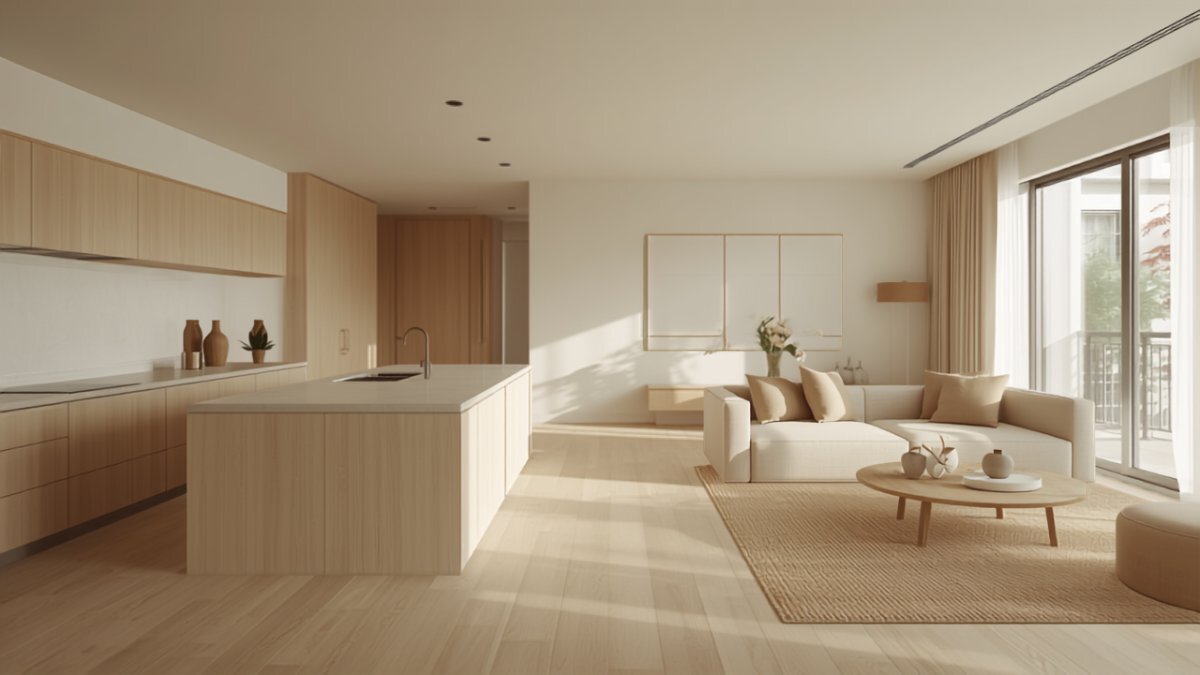
Choose a single material for the cabinetry and let it run. Vertical grain across all visible doors. Counter in a quiet stone — a soft cream quartz or a honed terrazzo, not a high-veined Calacatta. The island, if you have one, becomes the room's calm centre rather than its loud focal point.
If you have a peninsula, treat it as furniture. Low-profile, generous radius on the corners, soft-close throughout. A peninsula that doubles as a breakfast counter should feel like a piece of millwork, not an extension of the kitchen.
And then leave space. A condo kitchen with restraint has more luxury, year over year, than one packed with features.
Material choices that survive 90% humidity
Singapore's climate is the silent test that decides which kitchens age well. Year-round humidity between 80% and 90% will warp poorly-chosen materials within five years. Choose with the climate in mind.
Visible cabinet doors and side panels. Premium E1-grade melamine particleboard with vertical-grain finish. Properly edge-banded on all six sides. Resistant to moisture, to thermal movement, and to the daily wear that solid wood cannot match in our climate.
Wet-zone carcass — under sink, around dishwasher. High-moisture-resistant HMR board, or marine-grade plywood for the most demanding zones. The cost premium is small. The lifespan difference is large.
Hardware. Stainless steel or Blum-grade German hinges and drawer runners. Hardware is what fails first in tropical kitchens. Spend here.
Finish. Matte, every time. Gloss shows every fingerprint and every speck of cooking grease. Matte ages into character.
What about solid wood? It belongs in furniture, not in kitchen cabinetry. Singapore's humidity will move solid wood, season after season — joints loosen, doors warp, drawers stick. The Japandi look that solid-wood doors promise is delivered more honestly by vertical-grain melamine that doesn't move.
The honest cost picture
Japandi cabinetry in Singapore sits in three honest tiers.
Entry tier — S$8,000 to S$15,000. A 4-room HDB kitchen, modular Japandi cabinetry from a range like Shuno, vertical-grain melamine, soft-close drawers, decent hardware. The most-cabinet-for-the-money tier. Suits BTO upgraders.
Mid tier — S$15,000 to S$30,000. Semi-custom Japandi cabinetry. Better hardware (full Blum), better materials (E1 throughout, HMR in wet zones), integrated appliance housing, a considered hidden lighting layer. The honest sweet spot for the considered HDB and most condo homes.
Bespoke tier — S$30,000 and above. Fully custom Japandi cabinetry. Material library access, on-site survey, 3D drawings, dedicated project manager, premium finishes. Suits condo and landed homes where the kitchen is the heart of a 10-year home.
These numbers are the cabinetry, not the renovation. A full kitchen renovation — including counters, sinks, appliances, plumbing, tiling — typically lands at 2 to 3 times the cabinetry budget.
Where Arimokko fits — and where we don't
Arimokko has spent 27 years making cabinetry in Singapore and Senai. Our Mokko Kitchen range is built specifically around the Japandi specification — vertical-grain melamine, handleless fronts, integrated appliance housing, the kueh-tray drawer that we test against real Singapore festive kitchens.
We work directly with homeowners through our Aperia design office, and with interior designers through our trade programme. Our factory in Senai handles both — short supply chain, factory-direct quality, the same cabinetry whether you live in Bukit Timah or Bukit Mertajam.
Where we don't fit — the Modern Luxury kitchen with dark veneers, brass handles, and high-gloss lacquer. There are firms in Singapore that do that work beautifully. We are not one of them. We make quiet kitchens, in light wood, for homes that have decided their kitchen should age well.
Where to begin
Start with how you cook, not what you want.
Open your current kitchen. Look at where the kettle lives. Look at the corner where the rice cooker sits. Look at the drawer that holds the kueh trays in the season before Chinese New Year, and the cabinet that holds the claypot. The next kitchen should be designed around those moments — the ones you have every morning, and the ones you have only twice a year.
Then come in. Visit our Aperia design office, by appointment, and we'll plan the kitchen the way you'll actually use it. Bring photos of your current kitchen. Bring photos of the kitchen you've been quietly saving on your phone. We'll meet you in the middle.
There is a moment, just before the kettle starts, when the kitchen is still asleep. We design for that moment. We hope your next kitchen does too.
Begin a quiet conversation.
Visit our Aperia design office, by appointment. 12 Kallang Avenue, #03-07, Aperia Mall.
WhatsApp +65 8821 1455.