
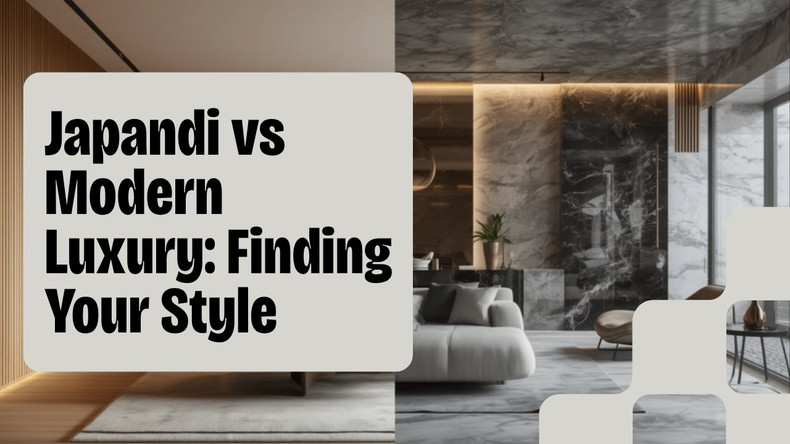
Walk through any Singapore interior design showroom in 2026 and you will see two distinct worlds side by side. On one wall: warm timber, linen upholstery, quiet joinery, the deliberate absence of ornament. On the other: fluted stone panels, brushed brass hardware, velvet seating, layered textures that signal investment at every turn. These are not simply aesthetic preferences. They represent two genuinely different ideas about what a home is for.
Japandi vs modern luxury Singapore: the defining difference
The fundamental distinction between Japandi and modern luxury in Singapore is not visual — it is philosophical. Japandi asks: what can be removed? Modern luxury asks: what can be added? Both questions produce beautiful results. They produce very different spaces.
Japandi, as it has been interpreted in Singapore, draws on the Japanese concept of negative space — the productive emptiness between things — and the Scandinavian instinct for functional warmth. The result is interiors that prioritise material quality over surface decoration, negative space over layered detail, and a kind of quietness that does not read as austerity.
Modern luxury, as it is practised in Singapore, typically signals itself through material weight and surface richness. Fluted marble, textured wallcovering, statement lighting, and bespoke hardware are the vocabulary. The intention is comfort that announces itself — a home that communicates its quality clearly and immediately to anyone who enters.
What drives each approach
Neither approach emerged from nowhere. Modern luxury in Singapore is partly a response to the constraints of HDB and condo living — if the space cannot be large, it can at least feel rich. Layered textures and statement finishes are a way of compensating for footprint. There is a logic to this that goes beyond mere display.
Japandi, on the other hand, tends to attract clients who have reached a particular relationship with their possessions. They have accumulated things, lived with clutter, and decided they would rather not. The Japandi brief often comes from people who are simplifying — not because they cannot afford more, but because they have decided they prefer less. This is a meaningful distinction from austerity by necessity.
There is also a generational dimension. Younger Singapore homeowners, particularly those in their early thirties taking on BTO or resale flats, have grown up with visual culture that celebrates Japanese minimalism. The Instagram generation has seen Kyoto ryokan interiors and wabi-sabi aesthetics long enough that they feel genuinely aspirational rather than foreign. Modern luxury, by contrast, has a longer history in Singapore and tends to attract clients who associate richness of material with earned comfort.
Where they overlap
The two approaches are not as opposed as their most extreme expressions suggest. The overlap zone is occupied by interiors that use high-quality materials with restraint — marble countertops in a handleless kitchen, brass tapware against a muted tile palette, a statement light pendant in an otherwise simple dining room. These are not compromises. They are syntheses, and they are increasingly common in Singapore renovations.
Both approaches also share a commitment to craftsmanship. Modern luxury requires precise detailing — badly executed fluted panels or poorly finished stone reads as imitation rather than investment. Japandi is equally unforgiving: a poorly made cabinet or an inconsistent grain match undermines the entire quiet register of the design. The tolerance for visible craft imperfection differs between the two approaches, but neither accommodates poor execution.
Who they suit
Japandi tends to suit clients who want their home to recede — to be a container for life rather than a participant in it. They want good light, comfortable furniture, and surfaces that do not compete for attention. They are often people who work in creative fields or who are simply tired of visual complexity in their daily lives.
Modern luxury tends to suit clients who want their home to feel like an achievement — a tangible expression of what they have built. This is not vanity; it is a genuine and legitimate way of relating to one’s living space. A home that feels generous and rich is a specific kind of pleasure, and it is one that modern luxury delivers when executed well.
The two approaches also map, roughly, onto different budget relationships. Japandi can be executed beautifully at a moderate budget if the joinery is well made and the palette is disciplined. Modern luxury tends to require higher material costs — stone, solid brass, and quality velvet are not inexpensive — though the finished cost varies widely depending on scope.
Where they diverge fundamentally
The deepest divergence is in the relationship to time. Japandi interiors are designed to settle — to look better as materials age, as timber develops a patina, as the linen softens. The aesthetic assumes that the home will change slowly alongside its occupants.
Modern luxury, particularly in its more fashion-adjacent expressions, is designed to look exceptional at a moment in time. A heavily textured wallcovering or a trending stone pattern may age in ways that feel dated rather than characterful. The luxury of the present may require periodic refreshing to remain luxury.
This is not a flaw in modern luxury — it is simply a different relationship to design time. Some clients enjoy the process of periodically updating their interiors. Others want to make decisions once and live with them for twenty years. Japandi is better suited to the latter; modern luxury rewards the former.
No judgement — just clarity
Both design languages are responses to real human needs and genuine aesthetic values. Singapore is large enough, and varied enough, for both to thrive. What matters is that clients understand which approach reflects how they actually want to live — not how a showroom suggests they should want to live.
The clearest question to ask is not “which is better” but “which one would I choose to come home to, every day, for the next ten years?” The answer to that question is usually honest.