
Ask this question in a Singapore property forum and you will get a confident, frightening answer: it is illegal to subdivide an HDB flat — your flat may get confiscated. Ask a renovation contractor and you may get a shrug. Ask us, and we will tell you what we have learned from years of building the walls, doors and kitchenettes that make these homes work: the truth sits quietly in the middle, and it is worth knowing exactly where.
First, what a dual-key conversion actually is
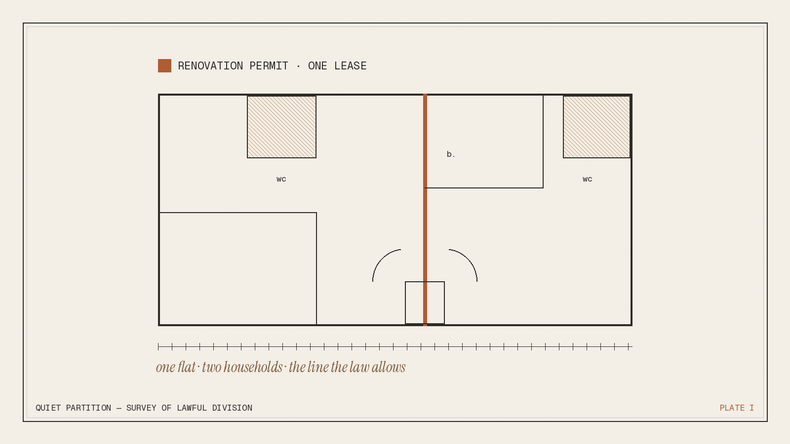
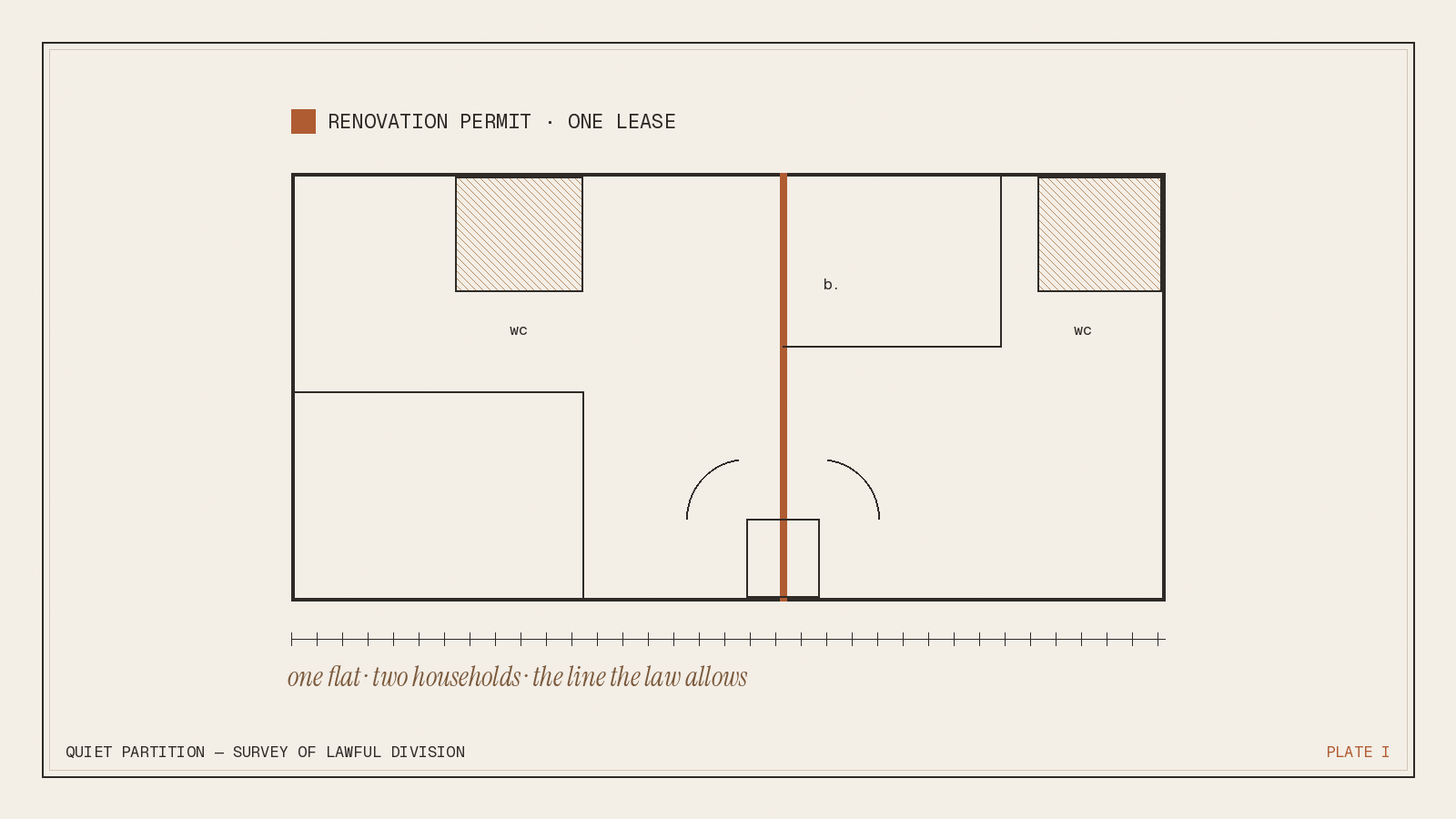
A dual-key HDB is not two flats. It is one flat, on one lease, arranged so that two households can live side by side without living on top of each other. Typically that means a main home and a smaller self-contained space — a studio with its own sleeping area, bathroom, a modest kitchenette, and a door that closes with intention.
That last sentence matters legally. Because the flat remains one unit under one lease, you are not subdividing property. You are reconfiguring the interior of your own home. HDB has no official dual-key category — what you are doing, in HDB's eyes, is a renovation.
What is legal
A dual-key layout is achievable within HDB's ordinary renovation framework, provided you follow it:
A renovation permit is required. Hacking or building walls needs an HDB permit, applied for through an HDB-registered contractor. This is the same permit regime as any substantial renovation — nothing exotic.
Partition walls are allowed. New internal walls — whether masonry, drywall, or the full-height joinery partitions we build in our own workshop — are permitted with approval. A well-built carpentry partition has an advantage worth knowing: it can be reversed cleanly when your needs change, which matters for resale.
A kitchenette is possible. A second cooking space is where most conversions live or die. Wet works and electrical loading need approval, and gas is generally off the table for a secondary space — think induction hob, compact sink, integrated fridge. Done in joinery rather than heavy construction, a kitchenette stays within renovation rules and stays reversible.
Renting out the sub-unit is legal — under bedroom-rental rules. Because the flat is still one unit, letting the studio is treated as renting out bedrooms. That means: your flat must be 3-room or larger, you need HDB's approval before the tenancy starts, and — this is the one people miss — you must continue living in the flat with your tenants. The upside: bedroom rental is allowed even before your five-year MOP is up.
What is not legal
The forum warnings are not invented from nothing. They describe a different thing:
- You cannot create two legal units. No second address, no separate utilities account, no subdividing the lease. One flat, one household of record.
- You cannot move bathrooms. HDB does not allow the relocation of toilets and bathrooms; your layout must work with where the wet areas already are. This single rule decides which flats convert well.
- You cannot rent the sub-unit as if it were a separate flat while living elsewhere. Renting out the whole flat requires MOP completion and approval; pretending a partitioned corner is an independent apartment is exactly the unauthorised partitioning that gets flats into the news.
- Occupancy caps still apply. Currently up to 8 persons for a 4-room or larger flat (a relaxed cap in place until 31 December 2026), 6 for a 3-room.
So: conversion, legal with permits. Subdivision, never. The confiscation stories come from owners who did the second thing, not the first.
Where carpentry earns its keep
We are carpenters, so we notice what the regulations quietly reward. Every rule above favours work that is precise, light and reversible:
- A joinery partition with an integrated storage wall divides space without loading the structure — and comes out cleanly in a day if a future buyer wants one open home again.
- A kitchenette built as a single run of cabinetry — hob, sink, fridge, bin, all in two metres — needs far less approval-sensitive wet work than a rebuilt kitchen.
- Acoustic detailing matters more in a dual-key than in any other home we build. Two households share one slab; a partition should be built like it knows that.
The honest caveats
Not every flat can do this. You need size (roughly 1,000 square feet up — 5-room, jumbo, maisonette), a workable entrance position, and bathrooms in the right places. Conversion is a serious renovation — recent projects in Singapore have run from around $100,000 to $160,000. And a dual-key layout narrows your resale audience; reversibility is not a detail, it is the exit strategy.
Rules also change. Before you commit, verify the current renovation and rental rules on HDB's own pages, and put your specific floor plan in front of someone who has built these before.
A door, considered slowly
A dual-key home is really a question about how a family wants to live — parents nearby but not underfoot, a tenant helping with the mortgage without walking through your living room. The law allows more than the forums fear, and less than the property gurus promise.
When you are ready to look at your own floor plan, we will walk it with you — slowly, with measurements, and with no obligation to build with us at the end of that conversation.
Arimokko has built bespoke carpentry for Singapore and Malaysian homes since 1999. Design-and-build enquiries for dual-key conversions are handled with our RH Design & Build team; kitchenettes are the small, serious speciality of Mokko Kitchen.