
Run your hand along a wall in most HDB flats and you feel the day stored on it: the bag hook by the door, the shoe rack that overflowed, the open shelf carrying more than it was meant to. HDB storage ideas usually arrive loud — taller units, deeper cupboards, another rack bolted on. The Japandi answer is quieter. It asks each wall to hold what you need and to keep its calm while doing it, so the room breathes even when it is full.
That quiet is not an accident. It is the result of deciding, wall by wall, what earns its place and what can disappear behind a flat front. Below is how we think about storage at Arimokko when the brief is a small Singapore home and the feeling we are after is rest.
HDB storage ideas that begin with the wall, not the box
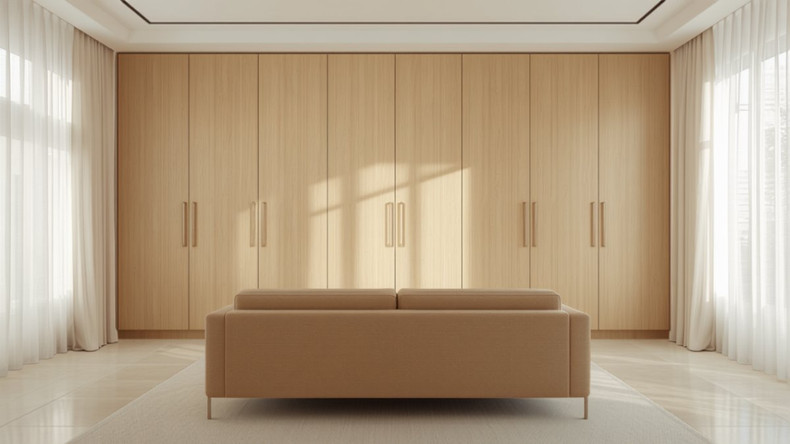
Most storage planning starts with volume — how many litres, how many shelves. Japandi storage starts with the plane of the wall and protects it. A wall that reads as one continuous, handleless surface feels larger and calmer than the same wall broken into visible boxes, even when the cabinetry behind it is identical. The trick is to let the joinery run floor to ceiling in a single material and a single grain direction, so the eye travels without stopping.
In practice that means full-height carcasses rather than a base unit with a gap above it, push-to-open fronts instead of handles, and a shadow gap where the cabinetry meets the ceiling so nothing looks crammed. The storage volume can be generous. What you remove is the visual noise.
The entrance: a threshold that holds the day
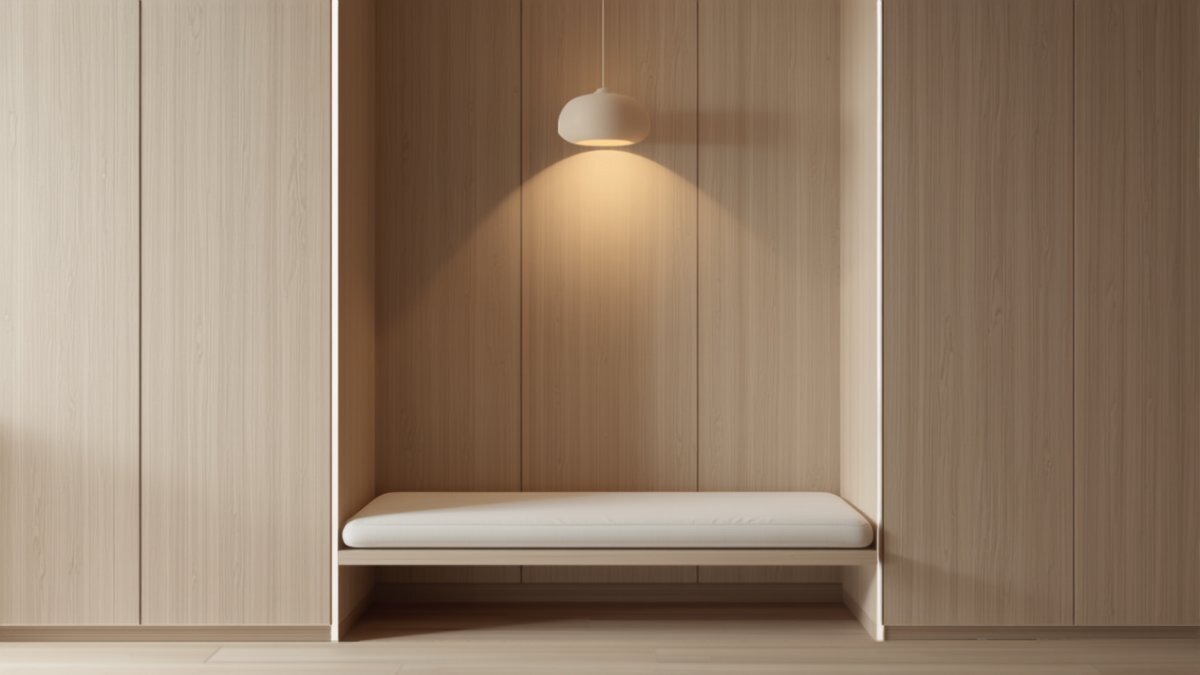
The first metre inside an HDB flat does the most work and gets the least design thought. Shoes, keys, umbrellas, the parcel you have not opened. A Japandi entrance gives all of it a closed home: a full-height shoe cabinet with a ventilated back, a recessed niche at hip height for keys and a small tray, and a bench seat with concealed storage beneath for the things that have no other place.
Leave one open shelf — a single ledge in light oak for a bowl, a sprig of something green, the day’s post. One open gesture against a wall of closed fronts is enough. More than that and the threshold starts to shout again.
The living wall: storage that disappears at eye level
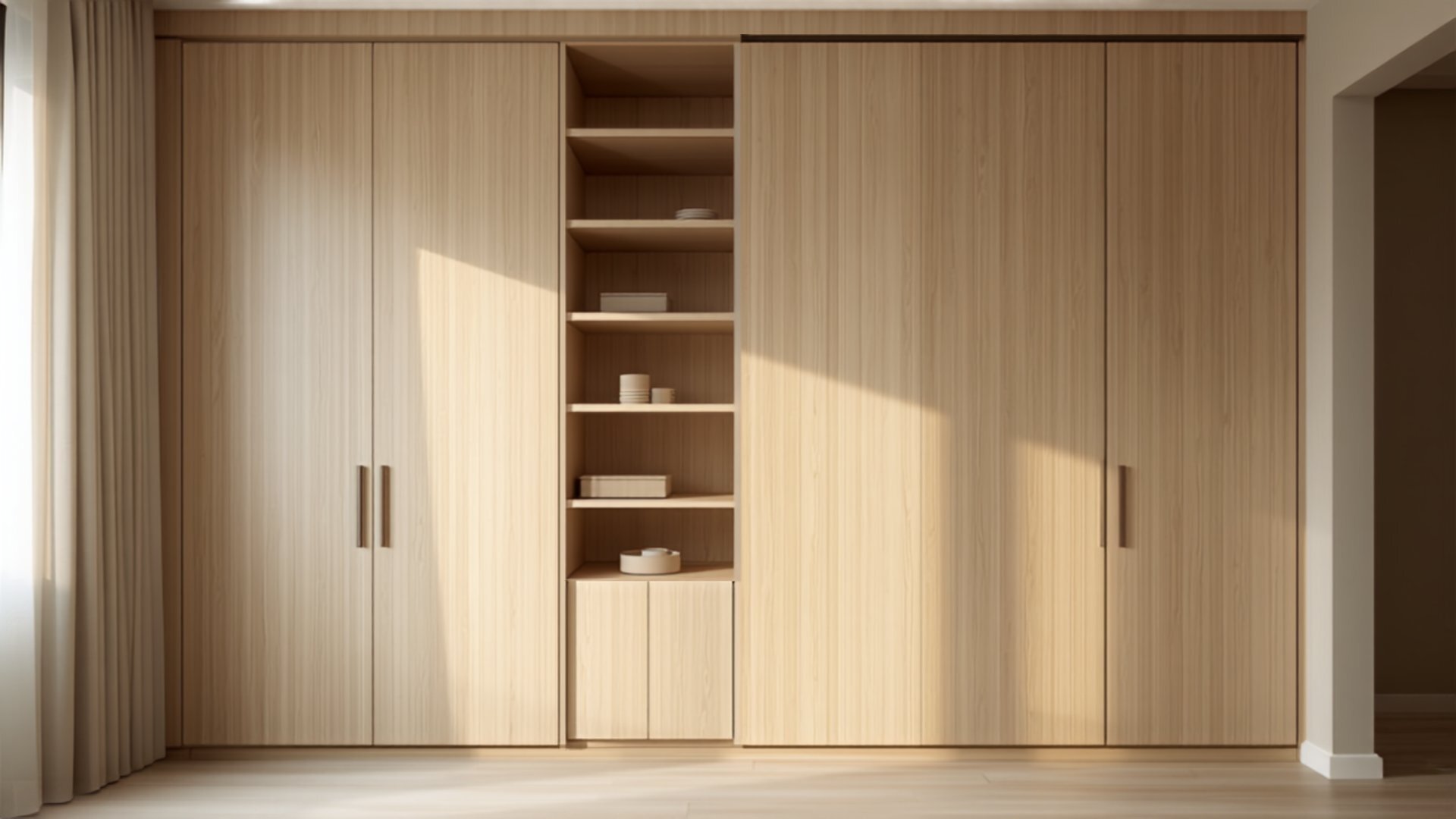
The temptation in a living room is the feature wall of open shelving. It photographs well and lives badly, because open shelves collect both objects and dust, and they ask you to curate every day. Japandi inverts the ratio. Keep roughly four-fifths of the wall closed and continuous, and reserve a small band — one niche, one run of open shelf — for the few things you genuinely want to see.
Behind the closed fronts goes everything the room actually accumulates: cables, chargers, board games, the router, paperwork. A flat-fronted wall that hides all of that is doing more for the calm of the room than any styled shelf ever will. This is where the Japanese idea of ma — the considered emptiness between things — does real work: the empty stretch of wall is not wasted, it is the part that lets the rest settle.
The bedroom: closing the day softly
An HDB master bedroom rarely has the floor area for a walk-in, so the wardrobe becomes the largest single surface in the room. Treat it as architecture rather than furniture. A wall-to-wall, ceiling-height wardrobe in a warm matte finish recedes; a freestanding unit with trims and handles advances and crowds the bed.
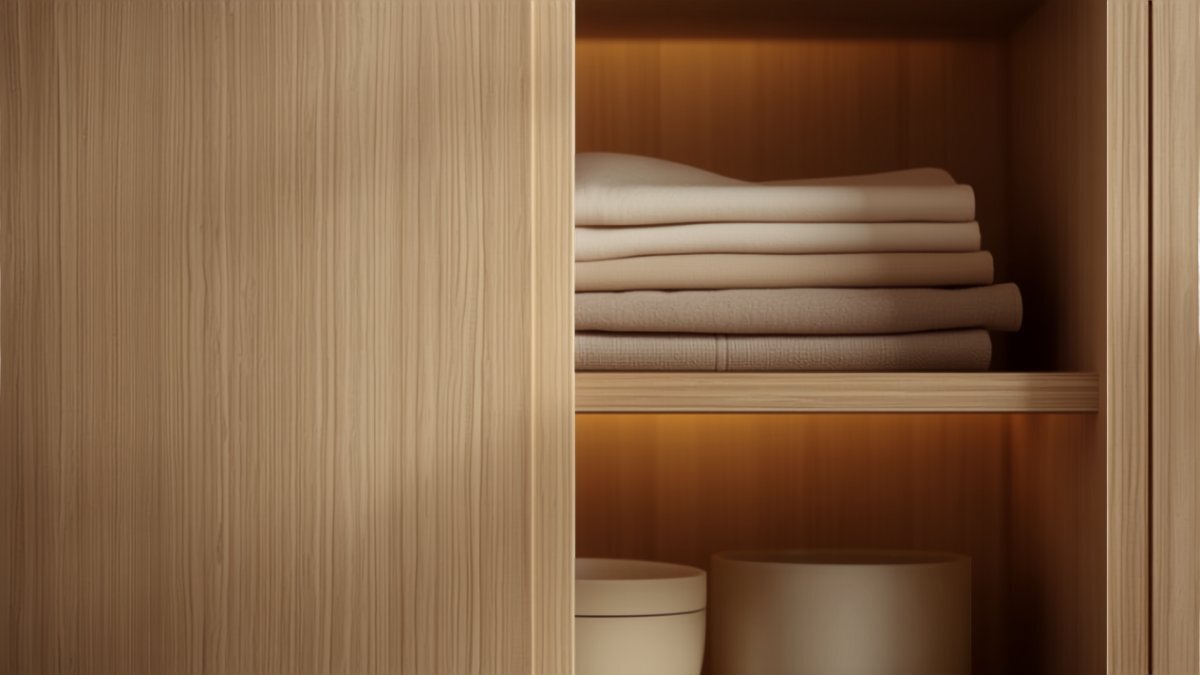
Inside, the discipline is the same as outside: a place for each thing so the doors can stay shut. Soft-close runners, a mix of hanging and drawers sized to what you own, and a shallow valet shelf for the watch and the glasses at the end of the day. The bedroom is the one room where storage should be felt and not seen.
The kitchen: tall, flat and humidity-honest
Singapore’s kitchens carry the most and hide the least. A bank of full-height units along one wall — pantry, tall appliance housing, concealed bins — frees the worktop and keeps the room reading as one quiet plane. Handleless fronts wipe clean and stay calm. Our Mokko Kitchen approach leans on this: storage that sits flush, opens to a touch, and asks nothing of the eye while you cook.
Material matters more here than anywhere because of the climate. In a flat that sits at high humidity for much of the year, the carcass should be moisture-resistant board with sealed edges, and the boards we specify are E1-rated for low formaldehyde so the air in a closed kitchen stays as honest as the joinery. Storage that warps or off-gasses is not storage you can live quietly beside.
A short method for your own walls
If you are planning HDB storage ideas room by room, three questions keep the result quiet. First, can this run go full height — floor to ceiling, ceiling to wall — so it reads as one surface rather than stacked boxes. Second, can the fronts be handleless, so the plane stays unbroken. Third, of everything this wall will hold, what genuinely deserves to be seen — and can the rest disappear behind a flat front.
Answer those honestly and most walls resolve themselves. The storage volume stays generous. What leaves the room is the clutter of the storage announcing itself.
Where Arimokko comes in
We design and build bespoke carpentry for homes in Singapore and Malaysia, made in our own Senai workshop and fitted to the exact dimensions of your flat. Japandi storage is not a finish we apply at the end; it is decided at the planning stage, when we work out which wall holds what and how to keep each one calm. If your HDB feels loud at the edges, the fix is usually not more storage. It is storage that knows how to stay quiet.