
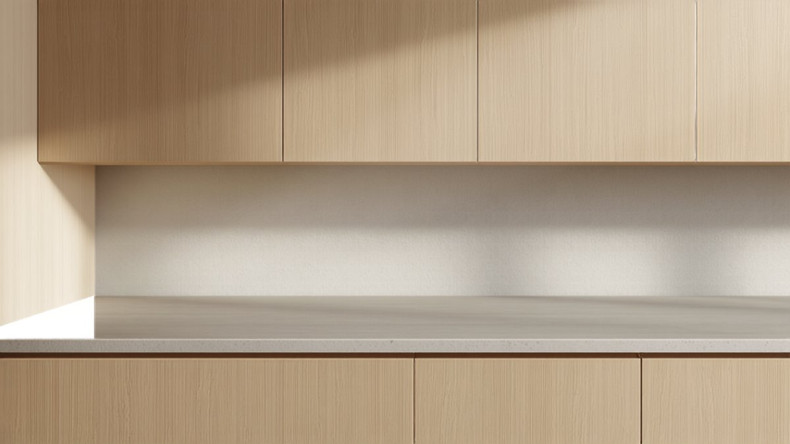
No handles is not a style decision. It is a decision about how a room holds silence — and there are three ways to build it.
Run your palm along a Japandi kitchen front and nothing interrupts it. No knob, no bar, no cold metal — just grain, and then the soft give of a door that knows it is being asked to open. Handleless kitchen cabinets are the Japandi default, and most homeowners choose them by eye without being told there are three different systems behind that smooth face. The choice between them decides how the kitchen feels in the hand for the next fifteen years.
Handleless kitchen cabinets — the three systems
Push-to-open. A spring catch or electronic touch-latch behind the door. Press anywhere, the door breathes open. The cleanest face of the three — the front is entirely uninterrupted. Its honest weakness is the kitchen's busiest moments: with both hands full, there is nothing to hook a finger into, and a lean of the hip opens what you did not mean to open. Best on upper cabinets and tall larders, where contact is deliberate.
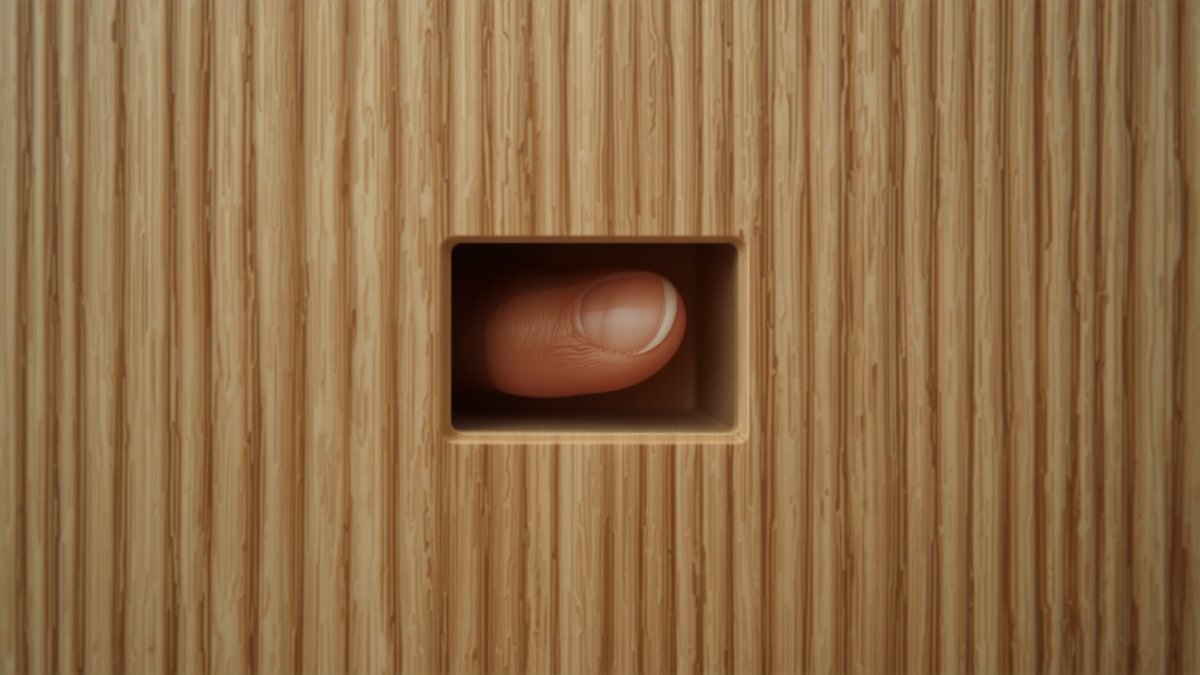
The J-pull. A curved recess machined into the top edge of the door itself. The fingers find it without looking; the face stays almost clean. It is the pragmatic middle path — no hardware channel to buy, no spring to wear out — and it suits drawers and base units that get opened fifty times a day. The recess does collect a little flour in a baking household. A damp cloth solves what design cannot.
The recessed channel. An aluminium profile — the trade calls it a Gola channel — set into the carcass between door and counter, creating a continuous shadow line across the kitchen. This is the system the showroom kitchens use; the dark horizontal groove is practically a signature of the genre. It costs the most, asks the cabinetmaker for the most precision, and rewards the kitchen with the strongest architecture. The shadow line is also where steam and grease settle, so it earns a wipe-down week by week.
Which system, in which kitchen
The honest pairing for most Singapore homes is a mix. J-pull or channel on the base units and drawers — the workhorses, opened with wet hands and full arms. Push-to-open above, where the faces matter most to the eye and the traffic is lighter. A household with small children leans further toward J-pull; little fingers and spring latches discover each other quickly.
In our climate the hardware grade matters more than the system. Humidity and daily steam are patient. Specify branded mechanisms — Blum or equivalent — and the door still opens the same way in year twelve. This is the cheapest place in the kitchen to overspend and the most expensive place to save.
What handleless asks of the cabinetmaker
A handled door forgives. The eye reads the handle, not the gap. A handleless front forgives nothing — the 3mm shadow gaps must run true across the whole elevation, which means the carcasses must be square, the floor's slope must be absorbed in the kick, and the hinges must hold their adjustment through years of humidity. Handleless is less a style choice than a precision commitment, and it quietly separates factories from workshops.
Where Arimokko fits
Every Mokko Kitchen is handleless by default — vertical grain, E1-grade board, gaps machined on the CNC line at our Senai factory rather than trimmed by eye on site. We will spec push-to-open, J-pull, or channel by zone, and we will tell you plainly where each one does not belong. The showroom drawer you try at our Aperia office is the same mechanism that goes into your home.
The hand remembers
A kitchen is touched more than any other room is touched. Whichever system you choose, choose it with your hands — open the drawer, press the door, listen to it close. The eye chose Japandi. The hand has to live there.
Begin a quiet conversation.
Visit our Aperia design office, by appointment. 12 Kallang Avenue, #03-07, Aperia Mall.
WhatsApp +65 8821 1455.