
The BTO kitchen is a room that many homeowners treat as a problem to be solved — constrained dimensions, a fixed window position, structural walls that cannot move. What experienced renovators know, and first-timers rarely do, is that the kitchen decisions made during a BTO renovation have an outsize effect on how the home feels five years later. Not because the kitchen is the most important room, but because it is the most used one, and the most visible from the rooms adjacent to it.
BTO kitchen Japandi decisions: five that compound over time
These are not the most glamorous renovation decisions. They are the ones that pay dividends quietly, without ever asking for credit. Each one reflects a Japandi sensibility — the preference for considered simplicity over short-term visual impact.
1. Handleless upper cabinets
The decision to specify handleless cabinets is one that clients consistently cite as the right call, years later. The visual reason is obvious: handleless cabinetry reads as cleaner and quieter, particularly in smaller BTO kitchens where handles can interrupt the sightline from the living area. The practical reason is less obvious but equally real: handleless cabinets accumulate less grease and dust in the hardware. There is nothing to clean around.
Mokko Kitchen’s approach to handleless design uses a reveal at the top or bottom of the door — a recessed grip channel that is part of the door profile itself. This is more durable than a separate push-to-open mechanism, which can loosen over time, and it gives the cabinet face a more integrated look. The reveal also allows the door to open cleanly even with wet hands, which matters in a working kitchen.
The caveat: handleless uppers work best when the cabinet profiles are precisely manufactured. A door that is even slightly out of square will show. This is a decision that rewards investment in quality manufacturing.
2. E1-grade board throughout
The board specification for kitchen cabinets is not a decision that clients think about until they do. E1-grade particleboard or MDF has lower formaldehyde emission levels than E2 or lower-grade alternatives. In a kitchen — a room with inherent humidity and heat — this matters for air quality and for the longevity of the board itself.
E1 board is also more dimensionally stable, which means that cabinet doors and drawer fronts are less likely to warp over time. In Singapore’s climate, where humidity swings between monsoon season and air-conditioned interior, stability is not a trivial specification. Cabinets that remain true to their original dimensions are cabinets that continue to look correct five years after installation.
The cost difference between E1 and lower-grade board is modest in the context of a full kitchen renovation. It is one of the least dramatic upgrades and one of the most consequential.
3. An integrated cooker hood
The standard kitchen hood — a canopy unit mounted beneath a cabinet — is functional but visually intrusive. In a Japandi kitchen, where the upper cabinet run is intended to read as a continuous horizontal band, a canopy hood interrupts the profile and draws the eye upward to a piece of industrial equipment.
An integrated hood — one that is built into the upper cabinet carcass and concealed behind a matching panel — resolves this. The kitchen reads as a composed piece of joinery rather than an assembly of appliances. The hood intake grille is visible only at close range. From the living area, the kitchen is simply a wall of quiet cabinetry.
The extraction performance of integrated hoods has improved significantly. Current models from reputable brands extract at comparable rates to equivalent canopy units. The maintenance access is slightly different — the filter is reached by opening a cabinet rather than reaching under a hood — but the trade-off in visual cleanliness is almost universally judged to be worthwhile.
4. Deep drawers rather than base cabinet shelves
The standard base cabinet configuration — two doors concealing a single shelf — is one of the most persistent inefficiencies in kitchen design. Reaching to the back of a base cabinet shelf requires the user to crouch, peer into the darkness, and navigate around whatever is stored at the front. Items at the back of the shelf are effectively inaccessible in daily use.
Deep drawers — three-drawer configurations that replace the base cabinet shelf entirely — solve this at the cost of slightly more hardware. Every item in a deep drawer is visible and accessible when the drawer is open. The drawer itself becomes an organisational system rather than a storage problem. Clients who have used both configurations almost universally prefer drawers for all base storage except the space directly under the sink.
The Japandi relevance here is organisational. A kitchen where storage is legible and accessible is a kitchen that stays orderly with less effort. Quiet tidiness is not achieved by hiding things — it is achieved by storing them in ways that make disorder unlikely.
5. Under-cabinet lighting on a warm circuit
Under-cabinet lighting is often specified as a functional addition — illuminating the countertop workspace for food preparation. This is correct, but it understates the impact. In a BTO kitchen where the main overhead light is typically centred and bright, under-cabinet lighting on a separate warm circuit transforms the atmosphere of the room in the evening.
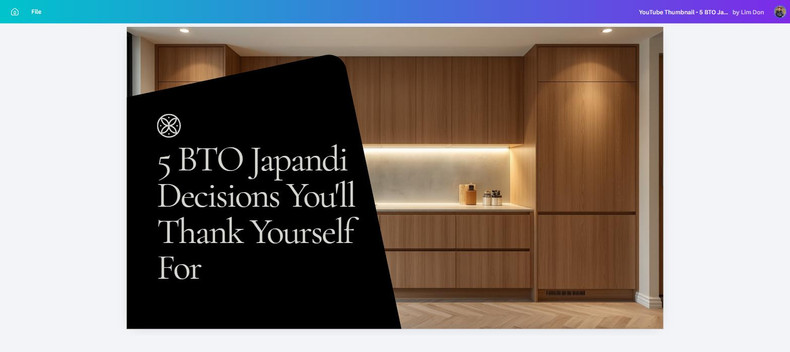
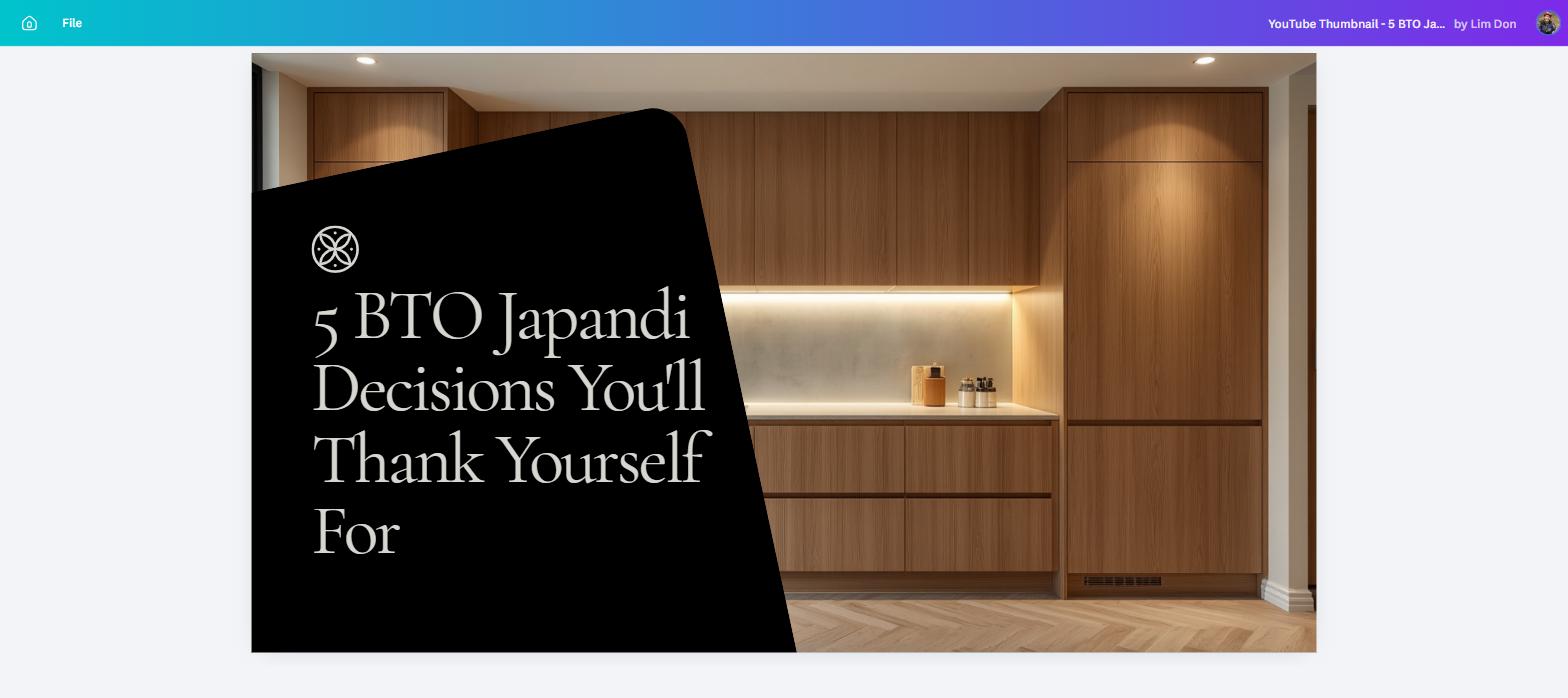
A warm-white LED strip at the base of the upper cabinets casts light downward across the countertop and picks up the grain of a timber-finish cabinet face. In the evening, with the overhead light off and the under-cabinet circuit on, a Mokko Kitchen becomes a completely different room — quieter, more intimate, more like a domestic space and less like a functional one.
The specification requirement is simple: a warm colour temperature between 2700K and 3000K, a separate switch or dimmer from the overhead light, and installation that conceals the strip behind a small shadow gap at the cabinet base. The cost is modest. The effect, five years on, is one of the renovation decisions that clients remember with uncomplicated satisfaction.