
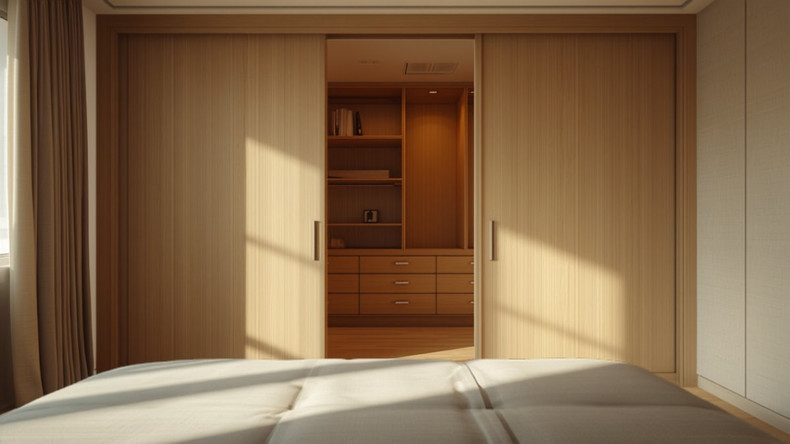
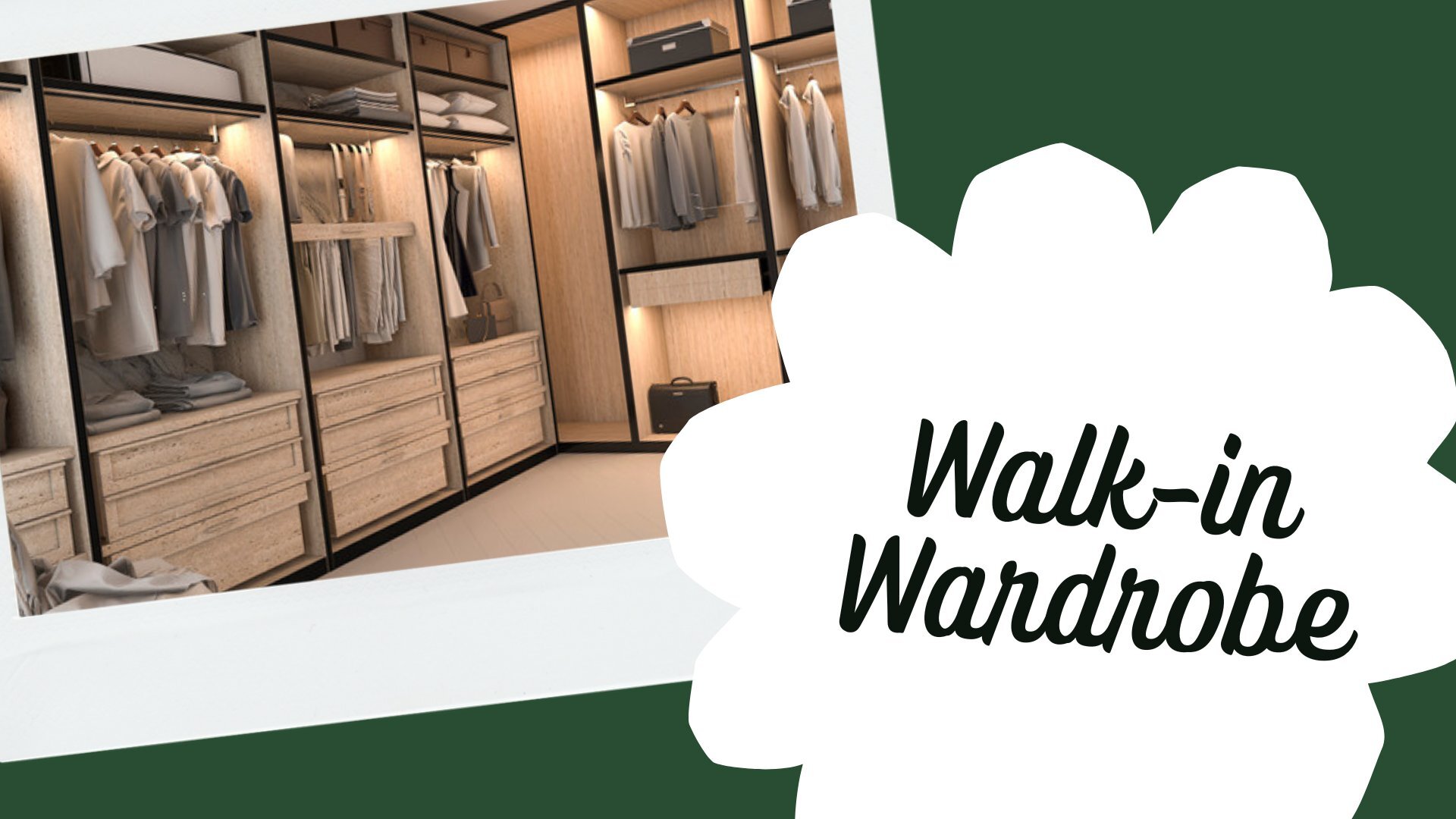
Seven in the morning, an HDB master bedroom. The sun comes in low across the parquet. A door slides open with a soft pull. Linen shirts hang in a row, pale against pale oak. A drawer eases out, the brass of a watch dial catches the light. The day begins, gently. This is a Japandi walk-in wardrobe in an HDB master bedroom — not a fantasy of space, but eight square metres put to careful use.
The walk-in wardrobe used to be a luxury reserved for landed homes. In Singapore, that has quietly changed. A four- or five-room HDB master bedroom often gives up enough floor area for a small dressing run if the owner is willing to give up the bed wall — or part of it. The trick is not in finding more space. It is in being honest about how little is needed.
The 8-square-metre reality — what actually fits
Eight square metres is the working footprint of most HDB master walk-ins we build. That is roughly 2.4 metres wide by 3.3 metres long, or a little narrower and a little longer. It is not generous. It is enough.
Inside that footprint, a Japandi walk-in wardrobe gives you two long runs of cabinetry facing each other, with a clear walking aisle of around 900 millimetres down the middle. Each run can hold a mix of hanging space, drawers, and shelves. There is room at one end for a full-length mirror. There is room at the other end for a chair, or a low bench, or simply the doorway. There is not room for a dressing island, and no Japandi wardrobe at this scale should pretend otherwise.
The honest plan starts with what the household actually owns. A wardrobe sized for an aspirational future fills up with empty hangers. A wardrobe sized for the clothes that are already in rotation breathes for years.
The Japandi rules for a small wardrobe
The same restraint that gives a Japandi kitchen its calm gives a Japandi walk-in its breathing room. A few rules tend to hold.
One material, two finishes. A pale oak veneer for the carcass and the open shelves. A soft matt lacquer in a quieter, slightly warmer tone for the drawer fronts. Nothing else. The eye should travel along the run without snagging.
Handleless or recessed pulls. A small wardrobe lives or dies on the visual quiet of its long lines. Knobs and bar handles fight that line. A J-pull or a finger-groove keeps the surface clean and the hand still finds the door.
Full-height fronts, drawn to the ceiling. The space above an HDB wardrobe is not optional storage; it is the difference between a calm room and one with a busy bulkhead. Take the cabinetry up. The seasonal luggage and the spare bedding live there.
Open shelving, used sparingly. One bay of open shelves for folded knitwear or for a small stack of bags is a Japandi grace note. Three bays of open shelves are visual noise. Restraint is the point.
Soft, indirect lighting. A warm 2700K LED strip behind the lip of each shelf or along the underside of the top rail. Not downlights. Not spotlights. The wardrobe should look like a quiet room, not a retail display.
Materials that survive Singapore's air
An HDB master bedroom in Singapore lives at 75 to 90 per cent relative humidity for most of the year. A walk-in wardrobe is one of the most demanding pieces of cabinetry in the home — fully enclosed, often shut for long stretches, holding fabrics that absorb moisture. The materials underneath the calm Japandi surface have to do real work.
We specify HMR (high moisture resistant) plywood carcasses for the bodies, with proper edge-banding sealed on all six faces. We avoid raw particleboard at any visible joint. We use low-formaldehyde boards as the baseline, not the upgrade. And we leave a small ventilation gap — usually a 10 millimetre shadow line at the back of each tall cabinet — for air to move.
None of this shows in the finished room. All of it is the difference between a wardrobe that closes softly five years from now and one that warps and smells of damp by the third monsoon.
How the day closes — the wardrobe at evening
The Japanese idea of kanso — the value of simplicity, of removing the unessential — earns its keep here. A walk-in wardrobe is one of the last rooms you use before sleep, and the first you use after waking. Its job is not to perform. Its job is to make those two transitions quiet.
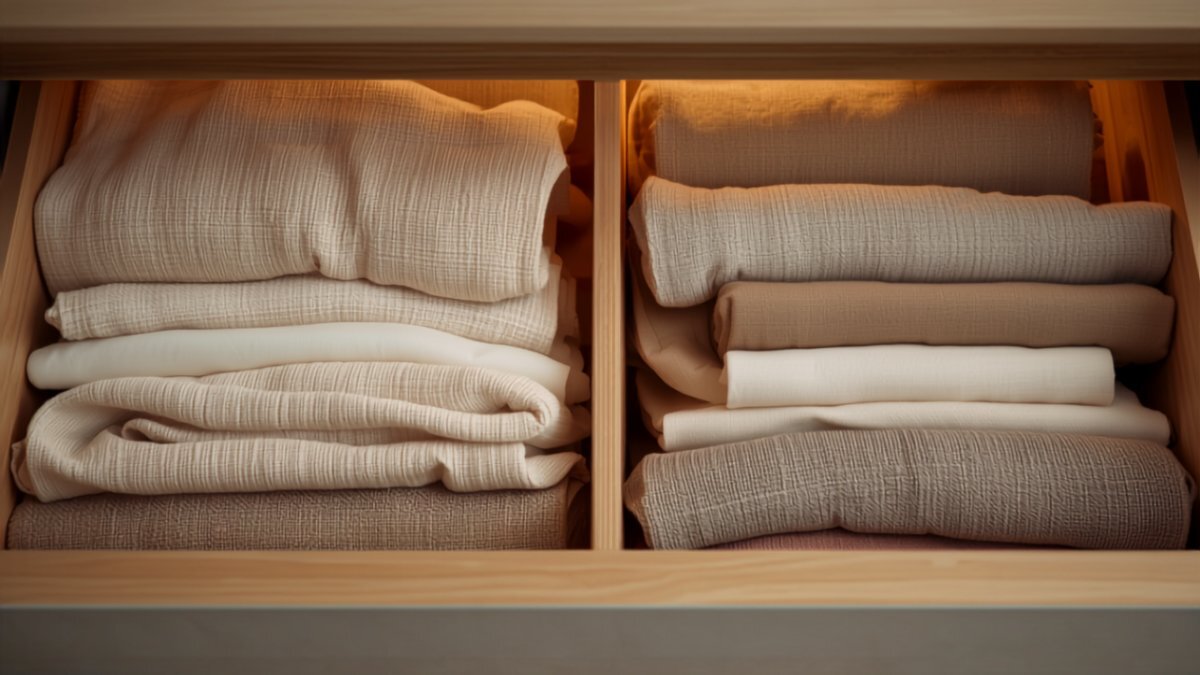
That changes the brief. A Japandi walk-in is designed for the gesture of returning a watch to its drawer, of hanging a shirt on a known peg, of opening a single soft drawer for socks without having to look. Everything has a place. Nothing competes for attention. The room ends the day with you.
An Arimokko walk-in wardrobe in an HDB master
The Shuno modular range, our Japandi modular system, was designed for exactly this footprint. A walk-in wardrobe in an HDB master bedroom is one of its most natural homes — eight square metres, two facing runs, one quiet aisle. The modules let us tune the mix of hanging, drawers, and shelves to what each household actually owns, while keeping the joinery quietly consistent.
Each build is measured on site. We look at the cornice height, the position of the air-con trunking, the swing of the existing bedroom door. The wardrobe follows the bones of the room, not a catalogue.
A quiet next step
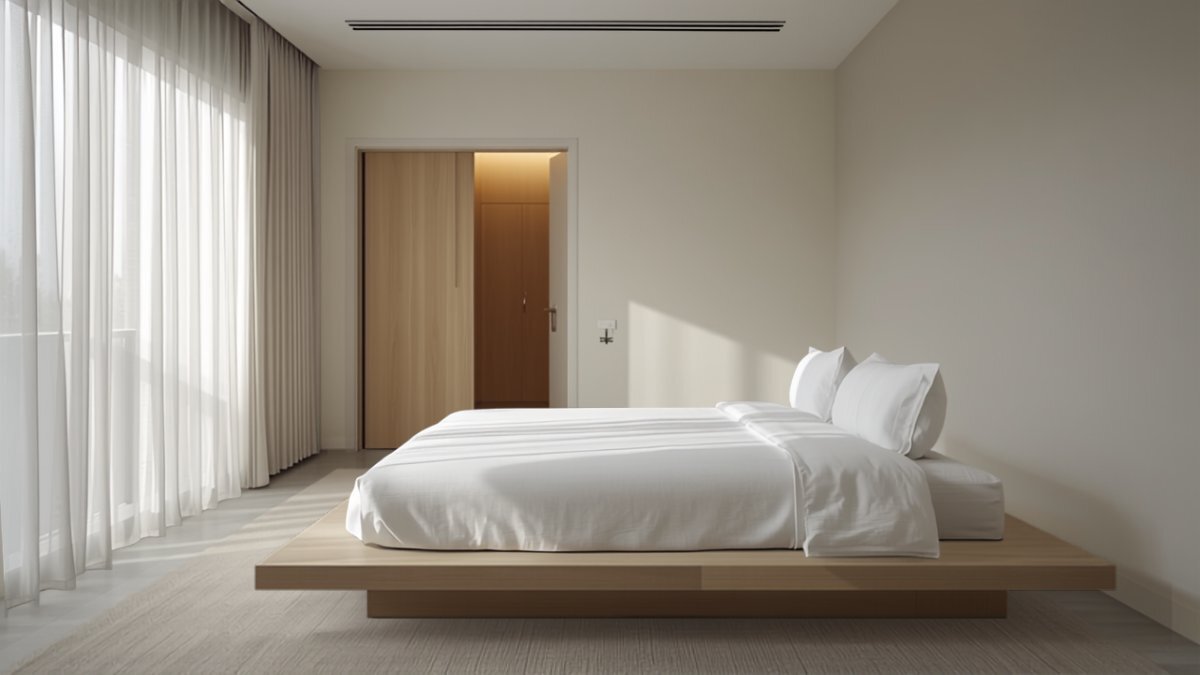
If you are planning a renovation in a four- or five-room HDB and have wondered whether a walk-in wardrobe is realistic in your master bedroom, the answer is usually yes — provided you are willing to design it for the clothes you actually wear, in the space you actually have.
To begin a conversation, write to us at hello@arimokko.com or visit arimokko.com. We design and build from a single workshop in Senai, and we are happy to walk an HDB master bedroom with you before any drawing is committed.