
Kitchen renovation KL Japandi: what the process actually involves
Kuala Lumpur homes have a particular quality of light in the early afternoon — the way it falls through jalousie windows or filters through frosted glass, diffused and warm. A Japandi kitchen renovation in KL works with that light rather than against it. Matte cabinet faces that absorb rather than reflect, warm timber undertones, stone or sintered worktops in pale neutral tones. The aesthetic translates well to Malaysian homes. The logistics of doing it properly are what most renovation guides omit.
This article covers the real experience of a kitchen renovation KL Japandi project: cost ranges, the variables that move price, lead times, the cross-border logistics involved when production is in Johor and the client is in Kuala Lumpur, and what the Mokko Kitchen range means for Malaysian homeowners specifically.
What drives the cost of a Japandi kitchen renovation in KL
A Japandi kitchen renovation in Kuala Lumpur ranges, in broad terms, from RM 25,000 to RM 75,000 for a full kitchen installation — excluding appliances. The range is wide because the variables that move price are significant. Understanding them is more useful than a headline figure.
Kitchen footprint is the first variable. A galley kitchen of 2.5 by 3 metres requires less cabinetry than an L-shaped kitchen of 4 by 4 metres with an island. Linear cabinet metres are the base unit of pricing.
Cabinet material specification is the second variable. MR board carcasses with melamine-faced door skins sit at the lower end. Plywood carcasses with matte lacquer door faces or genuine timber veneer sit at the upper end. E1-certified moisture-resistant board throughout, with marine-grade plywood in wet zones, sits in the mid-range and represents the responsible minimum for a Malaysian kitchen exposed to the same humidity conditions as Singapore.
Hardware specification is the third. Locally sourced hinges and drawer runners are cheaper but carry higher failure risk over five years. Blum or Hettich hardware costs more upfront and is significantly less likely to fail within the warranty period.
Worktop material is the fourth. Compressed quartz in a standard colourway is the most widely available. Sintered stone in a larger format is more durable and richer in appearance. Solid timber worktops require more maintenance but have a warmth that neither quartz nor sintered stone matches.
The Senai production advantage for KL clients
Arimokko’s production facility is at Senai, Johor — approximately 300 kilometres from Kuala Lumpur, a direct and manageable logistics run. For KL clients commissioning Mokko Kitchen, the supply chain is entirely domestic: design and specification in Singapore or KL, production at Senai, delivery to the KL site, installation by our team.
This matters for two reasons. First, there is no import duty or cross-border customs complexity — the cabinets are produced and delivered within Malaysia. Second, the production facility is close enough to KL that defect rectification, if required, is a manageable turnaround rather than a cross-border logistics problem.
For KL clients, the production-to-delivery lead time from Senai is typically shorter than for Singapore projects. From confirmed order to installation, the realistic window is seven to nine weeks. This assumes design sign-off has been completed and site measurements have been confirmed.
What the Japandi specification looks like in practice
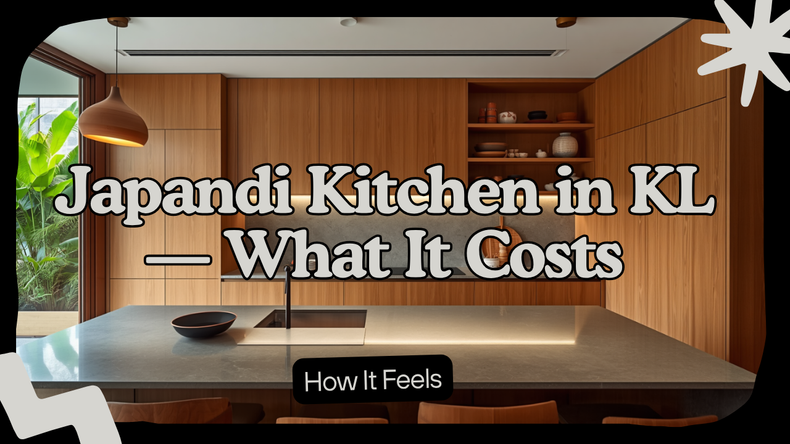
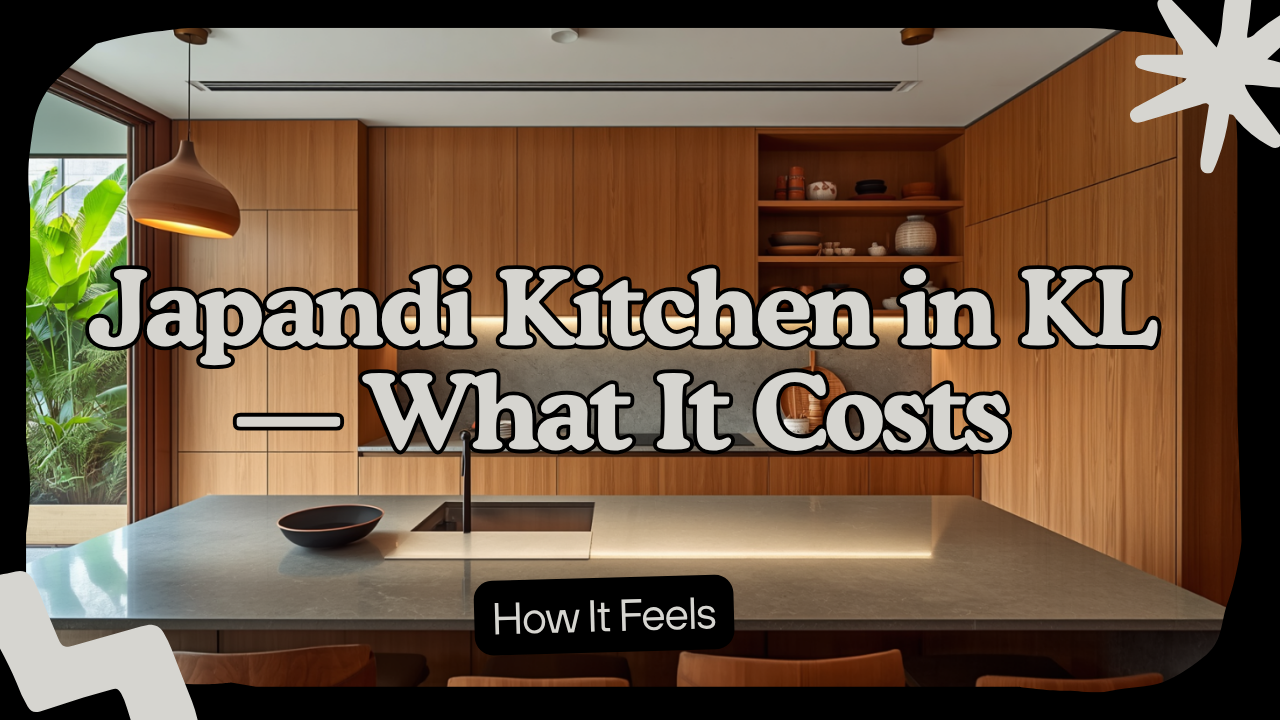
A Japandi kitchen renovation in KL will typically specify: upper cabinets in a matte lacquer warm white or pale grey, lower cabinets in a natural oak veneer or a textured laminate in a stone or linen finish. Worktop in pale sintered stone or compressed quartz. Splashback in large-format ceramic tile, white or off-white, minimal grout lines. Hardware in matte brushed brass or matte black bar handles, consistent throughout.
The kitchen layout in a Japandi renovation is simplified rather than maximised. An island is considered only if the footprint comfortably accommodates circulation of at least 900mm on each working side. If it does not, the island is excluded — a kitchen that is too full of furniture is not a Japandi kitchen, whatever the finish.
What is typically excluded from the renovation cost
Appliances, plumbing, electrical works, and floor tiles are typically outside the scope of a cabinetry contract and need to be budgeted separately. In KL, coordinating these trades requires either a main contractor managing the programme or direct engagement with each trade in the right sequence — electrical first, then plumbing rough-in, then cabinet installation, then tiling and splashback.
The renovation programme for a full kitchen in KL typically runs four to six weeks on-site from cabinet delivery to final snagging. Allow additional time at both ends — procurement and design finalisation before delivery, and minor touch-ups and cleaning after installation.
The honest case for spending in the mid to upper range
A kitchen renovation at the lower end of the range — RM 25,000 to RM 35,000 — typically involves standard MR board carcasses, commodity hardware, and limited design input. It will look acceptable on the day of installation and begin to show its compromises within three to five years. A mid-range renovation — RM 45,000 to RM 60,000 with E1-certified board, quality hardware, and considered material selection — will age well and require no significant intervention for ten to fifteen years.
The cost difference is real. The time-cost of replacing a kitchen that has failed prematurely is also real. A Japandi renovation done correctly, with materials and specification that suit Malaysia’s climate, is a ten-year decision, not a five-year one.