
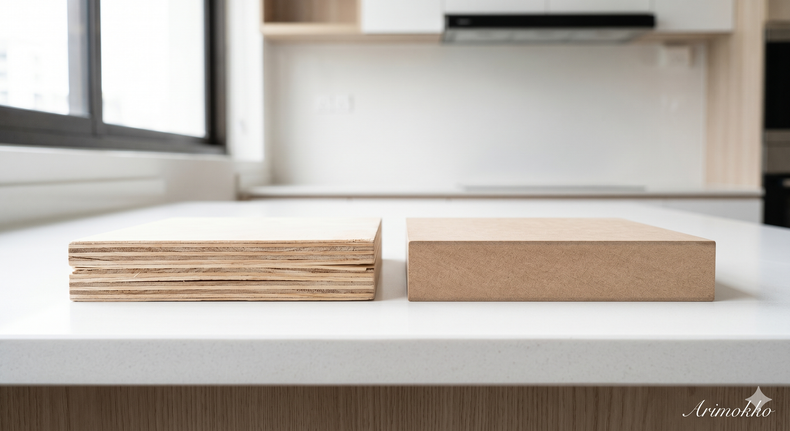
HMR vs. Plywood: Why High Moisture Resistant Boards are the Future of Singapore Kitchens
We all know the story. You spend months shortlisting IDs, scrolling through Qanvast, and visiting showrooms. You finally commit to your dream kitchen. It looks swee on renovation day. But flash forward two years, and the cabinets under your sink are starting to look a bit… cui.
The edges are peeling. The doors don't close right. It feels soft. Sound familiar?
In Singapore, we fight a constant battle against 80% average humidity. It is the silent killer of beautiful cabinetry. For decades, the "default" solution was marine plywood. But modern material science has introduced a superior contender that is quickly becoming the gold standard for the modern Singaporean kitchen: High Moisture Resistant (HMR) Boards.
At Arimokko, we prioritize engineering and durability over "what we've always done." Here is the technical breakdown of why we believe HMR is the only choice for a high-performance SG kitchen.
The Plywood Problem: Why it Fails the "Singapore Steam Room" Test
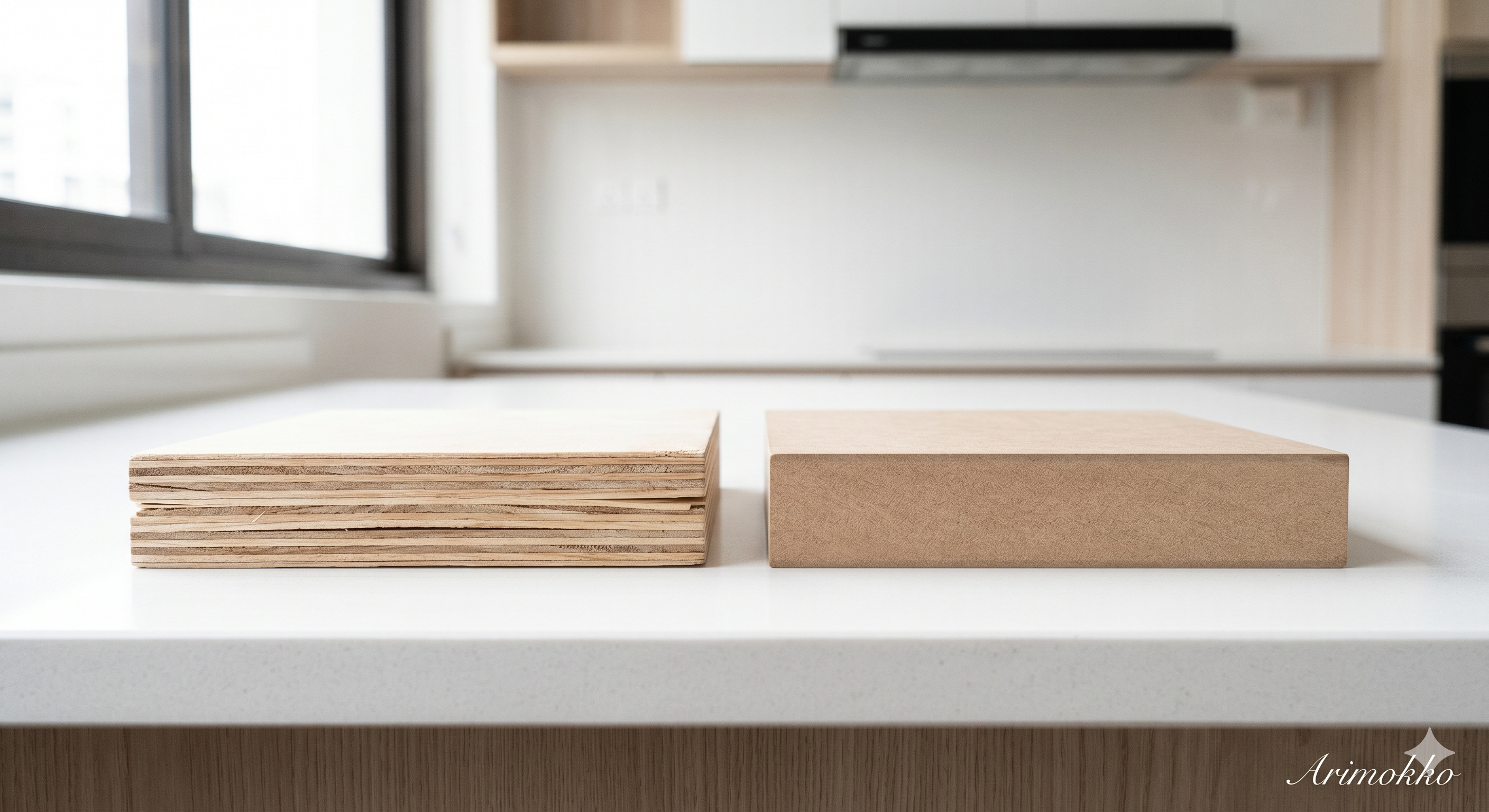
Traditional marine plywood is strong, yes. But it is constructed using an old philosophy: gluing thin layers of wood veneer together in a cross-grain pattern.
In a dry climate, this is great. But in a tropical kitchen, moisture is a constant aggressor. Plywood has a fatal weakness here: Delamination.
When moisture inevitably penetrates the edges of a plywood sheet—which always happens in the high-humidity danger zone under the sink—the water travels along those glue lines. Over time, the moisture weakens the bond, causing the layers to literally separate and swell. This internal tension is what leads to that warping and peeling effect that ruins expensive renovations. It’s a structural failure built into the material itself.
The HMR Advantage: Engineering Over Tradition
High Moisture Resistant (HMR) boards are a different beast entirely. We often describe HMR as being engineered "from the molecule up" for stability.
Instead of unreliable veneers, HMR boards are manufactured by bonding wood fibers with a specialized, moisture-repellent resin. The result is a homogenous, high-density material.
Because it is one solid, dense block, there are no internal layers to separate.
This provides a dimensional stability that plywood simply cannot match in Singapore's climate. The density means it resists localized swelling, and the homogenous core ensures that even if steam hits it daily, there is no internal tension to cause warping. It’s the difference between a stack of paper (plywood) and a solid block of polymer (HMR).
When you invest in an Arimokko kitchen using HMR, you are investing in a structure that won't fight against itself the moment the humidity spikes.
Beyond Moisture: Two Other Reasons HMR Beats Plywood
While moisture resistance is the main event, HMR offers other crucial benefits for a kitchen built to last:
1. Precision Finish
Plywood sheets often have slight variations in surface level or internal voids. HMR boards are manufactured to extremely precise tolerances. This perfectly flat surface is essential for achieving a flawless, premium finish when applying laminates or lacquers. A truly modern, minimalist Arimokko kitchen requires that precision.
2. Sustainable Sourcing
Plywood production often relies on the logging of slow-growing, old-growth hardwood forests. HMR is a composite board that uses fibers often sourced from fast-growing, sustainable plantation timber or recycled wood materials. Choosing HMR allows you to make a more sustainable choice for your home without sacrificing durability.
Don’t Just Renovate. Build to Last.
Marine plywood had its time, but it belongs to an era before modern composite engineering. Don’t fall for the "we’ve always done it this way" argument from a contractor.
In Singapore’s "steam room" environment, dimensional stability is the only defense your kitchen has. HMR is the definitive answer.
Build it right. Build it once. Build with Arimokko.
Ready to design a kitchen that stays beautiful? Visit our showroom to feel the HMR difference or book a consultation with our design engineers today.
Frequently Asked Questions (FAQ)
Q: Is HMR really better than "Marine Plywood" for my BTO/Resale kitchen?
A: In Singapore's 80-90% humidity, marine plywood can still delaminate over time because of its layered construction. HMR is a high-density, homogenous board with moisture-resistant resins bonded into the fibers, meaning there are no layers to peel apart. For long-term durability, HMR is the modern engineered choice.
Q: Can I use HMR for cabinets under the sink?
A: Yes, absolutely. In fact, that is where it shines most. The under-sink area is the "danger zone" for moisture. Because HMR doesn't have glue lines that moisture can travel through, it stays stable even when exposed to the occasional dampness of a kitchen sink area.
Q: Is HMR environmentally friendly?
A: Yes. At Arimokko, we prioritize sustainability. HMR boards often use wood fibers from sustainable plantations or recycled materials, making it a "greener" choice than logging old-growth hardwoods for traditional plywood.
Visit Arimokko – Your Singapore Carpentry Specialists
Ready to see the difference between HMR and Plywood for yourself? Come down to our showroom or factory to feel the quality of our materials.
- Design Office: 12 Kallang Ave, #03-07 Aperia Mall, Singapore 339511
- Showroom/Factory: 7 Mandai Link, #08-25 Mandai Connection (Blk B), Singapore 728625
- WhatsApp Us: +65 8821 1455
- Opening Hours: 11:00 AM – 9:00 PM Daily